Gravel Size Chart
Aggregate grades are numbered by sieve size, and the numbering is counter-intuitive — a smaller number means a larger stone. This chart maps every common grade to its actual size and its job.
Every common grade
"Fines" means the stone dust left over from crushing. It is the single most important column in this table: stone with fines compacts into a base, stone without fines drains.
| Grade | Nominal size | Contains fines | Primary use |
|---|---|---|---|
| #1 | 2.5" – 4" | No | Erosion control, culvert backfill, heavy rip-rap |
| #3 | 1.5" – 2" | No | Deep driveway base over very soft ground, drainage |
| #4 | 1.5" – 2.5" | No | Base layer of a deep driveway build, slope stabilisation |
| #5 | 1" | No | Road base, heavy driveway base |
| #8 | 3/8" | No | Paver setting bed, walkable driveway topping, concrete mix |
| #10 (screenings) | Dust – 1/8" | All fines | Paver joint filling, leveling under flagstone |
| #57 | 3/4" | No | French drains, driveway surface, pipe bedding, concrete |
| #67 | 3/4" – dust | Some | Driveway surface where a little binding is wanted |
| #411 | 3/4" – dust | Yes | Compacting driveway base and top layer |
| Crusher run | 0 – 3/4" with fines | Yes | The standard compacting base for anything |
| #21A / 21AA | 1" – dust | Yes | Road base, heavily trafficked driveway base |
| Pea gravel | 3/8" rounded | No | Patios, play areas, pool surrounds, dog runs |
| River rock | 1" – 8" rounded | No | Decorative beds, dry creek beds |
| Decomposed granite | 1/4" and fines | Yes | Compacted pathways, xeriscaping |
Why the numbers run backwards
The grades are ASTM D448 designations tied to sieve sizes, not to stone dimensions. A lower number corresponds to a coarser gradation. So #1 is huge rip-rap, #4 is a chunky 1.5-inch base stone, and #57 is a modest 3/4 inch.
Two-digit numbers like #57 and #67 indicate a blend spanning two single-digit gradations, which is why they contain a range of sizes rather than one uniform stone.
Regional names for the same thing
Quarries use local trade names, which causes real confusion when you are comparing quotes. These are all essentially the same compacting base material:
- Crusher run — most of the eastern US
- #411 — Ohio and the Midwest
- QP (quarry process) — New Jersey, New York
- DGA (dense grade aggregate) — technical and spec documents
- 21A / 21AA — Virginia, Michigan
- Road base — western US
- ABC (aggregate base course) — the Carolinas
If you ask for the wrong regional name you will often still get the right material, because yard staff know what a driveway base is. But it is worth asking whether the stone has fines in it — that is the question that actually matters.
Picking a size
| Job | Grade |
|---|---|
| Driveway base (deep build) | #4, then crusher run |
| Driveway surface | #57 or #411 |
| French drain | #57 washed |
| Paver base | Crusher run + #10 screenings |
| Walkway surface | #8 or decomposed granite |
| Shed pad | Crusher run |
| Decorative bed | Pea gravel or river rock |
| Play area | Pea gravel |
Once you know the grade, size the quantity with the crushed stone calculator, which carries the correct density for each one.
Tools for handling graded stone
As an Amazon Associate I earn from qualifying purchases.

FANTIAN 10 lbs Pea Gravel for Landscaping, 3/8 Inch Pebble Stone, Colorful
$29.99
View on Amazon →
VEVOR Landscape Rake, 36" Head Aluminum Lake Weed Rake with 75" Long Handle for Loosening Soil, Lawn Care, Weeding Lake, Garden, Silver
$37.48
View on Amazon →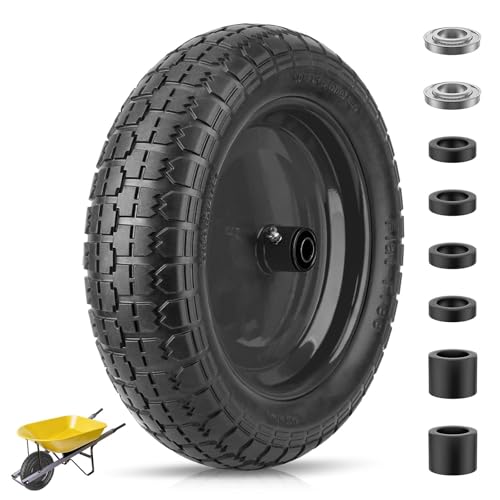
TICONN 4.80/4.00-8 Tire, 14.5" Flat Free Wheelbarrow Tire and Wheel
$34.95
View on Amazon →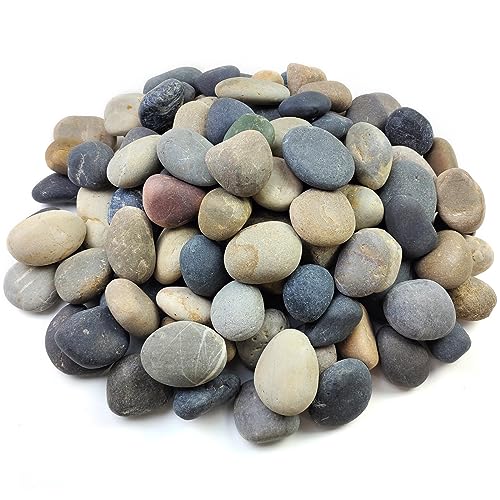
FANTIAN 20 lbs Natural River Rocks, 2-3 Inch Pebbles Rocks for Landscaping
$39.99
View on Amazon →Prices as of Sep 25, 2026, 6:18 PM UTC. Product prices and availability are accurate as of the date/time indicated and are subject to change. Any price and availability information displayed on Amazon.com at the time of purchase will apply to the purchase of this product.
Frequently asked questions
What size is #57 stone?
Nominally 3/4 inch. It passes a 1-inch sieve and is retained on a #4 sieve, so the actual pieces run roughly 1/2 to 1 inch.
Why is #4 stone bigger than #57 stone?
The numbers are ASTM grade designations, not dimensions. Lower numbers correspond to larger nominal sizes, so #4 (1.5 inch) is considerably larger than #57 (3/4 inch).
What is the difference between #411 and #57?
#411 contains stone dust and fines, so it compacts into a hard base. #57 is washed clean of fines, so it drains freely but stays loose.
What size gravel is best for a driveway?
Three-quarter inch — #57 or #411 — for the top layer. Larger stone is unpleasant to drive on and smaller stone washes away.
Get your gravel estimate in 60 seconds
Free, no signup required.
Get the Gravel & Stone Calculator app for Android
Estimate gravel, stone, sand, and mulch on the job site, save projects, and share quantities with your supplier.
Building something else? Try our sister calculators
Smart Roofing Calculator
Free roof replacement cost estimates by material and pitch.
Smart Decking Calculator
Deck cost, boards, joists, and stair estimates.
Smart Fencing Calculator
Fence cost by material and linear footage.
Smart Tile Calculator
Tile quantity, grout, and thinset estimates.
Smart Insulation Calculator
R-value, batt count, and blown-in coverage.
Smart Decking Calculator
Android app — deck cost, boards, and framing on site.
Smart Drywall Calculator
Android app — drywall sheets, mud, and tape estimates.
Smart Sod Calculator
Android app — sod rolls, pallets, and coverage.
Smart Insulation Calculator
Android app — R-value and batt coverage.
Smart Tile Calculator
Android app — tile, grout, and thinset quantities.
Smart Fencing Calculator
Android app — fence cost estimates on the go.