Pea Gravel vs Crushed Stone
Published September 6, 2026 · 8 min read
There is exactly one difference that matters between pea gravel and crushed stone, and everything else follows from it: crushed stone is angular and pea gravel is rounded.
Angular stone interlocks. Press it together and the faces wedge against each other into a surface that carries load. Rounded stone cannot do this — the pebbles roll past each other under any pressure. That is why one is a construction material and the other is a decorative surface.
Side by side
| Pea gravel | Crushed stone | |
|---|---|---|
| Shape | Rounded, water-worn | Angular, machine-crushed |
| Typical size | 3/8" | 3/8" to 2.5" by grade |
| Compacts? | No | Yes, if it contains fines |
| Load bearing | Poor | Excellent |
| Barefoot comfort | Very good | Poor — sharp edges |
| Stays in place | No — needs edging | Yes, once compacted |
| Drainage | Excellent | Excellent if washed, poor with fines |
| Price per ton | $35–$70 | $22–$55 |
| Density | ~1.35 tons/yd³ | 1.35–1.5 tons/yd³ |
Where fines change everything
Crushed stone is not one product. The critical distinction inside the category is whether it contains fines — the stone dust left over from crushing.
- Crusher run (#411, QP, dense-grade) keeps its fines. The dust fills the voids between stones and, once compacted, sets into something close to a soft pavement. This is base material.
- #57 and #8 stone are washed, so the fines are gone. Water passes straight through and the stone never locks up. This is drainage material.
Using the wrong one is the most common mistake in DIY gravel work: washed stone in a driveway base never firms up, and crusher run in a French drain silts the pipe within a couple of years.
Which to use, by job
| Application | Use | Why |
|---|---|---|
| Driveway base | Crusher run | Fines lock it into a load-bearing layer |
| Driveway surface | #57 or #411 | Angular, stays put under tires |
| French drain | #57 washed | No fines to clog the drainage voids |
| Paver base | Crusher run | Compacts flat and holds the screed line |
| Playground surface | Pea gravel | Rounded, soft on impact, no sharp edges |
| Pool surround | Pea gravel | Comfortable underfoot, drains fast |
| Dog run | Pea gravel | Kind to paws; crushed stone is not |
| Garden beds | Either | Aesthetic choice — both work over fabric |
| Shed pad | Crusher run | Must carry weight and stay level |
| Fire pit interior | #57 washed | Never rounded stone — see below |
One genuine safety issue
Never put pea gravel or river rock inside a fire pit. Rounded stone is rounded because water shaped it, and porous water-worn stone can hold moisture inside. Heat it hard enough and that trapped water turns to steam with nowhere to go, which can crack or pop the stone.
Use washed #57 crushed stone in the pit itself. Pea gravel is fine as the surround where people sit — just not in the fire. The fire pit calculator sizes both separately for this reason.
The cost surprise
Most people assume the decorative option is cheaper. It is the opposite: pea gravel costs more per ton than crusher run because it has to be washed and screened to a uniform round size, and it is often hauled further.
Pea gravel also usually needs edging, which crushed stone does not. Add $3.50 to $9.00 per linear foot around the whole perimeter and a pea gravel patio can cost noticeably more than a crushed stone one of the same size.
Can you use both?
Yes, and for decorative areas you generally should. The standard build is a compacted crusher run base with a pea gravel surface course on top. You get the stability of angular stone underneath and the comfort of rounded stone where you walk.
Both the gravel patio calculator and the pea gravel calculator size the two layers separately so you can order them as the different materials they are.
Gear and supplies featured in this guide
As an Amazon Associate I earn from qualifying purchases.

FANTIAN 10 lbs Pea Gravel for Landscaping, 3/8 Inch Pebble Stone, Colorful
$29.99
View on Amazon →
33ft. Galvanized Steel Landscape Edging (10-Pack) – 40" Metal Edging for Landscaping with 11 Stakes, Hammer-in Metal Landscaping Edging for Yard Pathway & Flower Beds – Lawn Edge for Garden Design
$69.99
View on Amazon →
HongWay 500 Pack 6 Inch Landscape Staples, Garden Staples Pins Galvanized 11 Gauge Ground Stakes Yard Lawn Staples for Turf Landscaping Fabric Fence Tent Irrigation Tube Outdoor Decorations
$37.99
View on Amazon →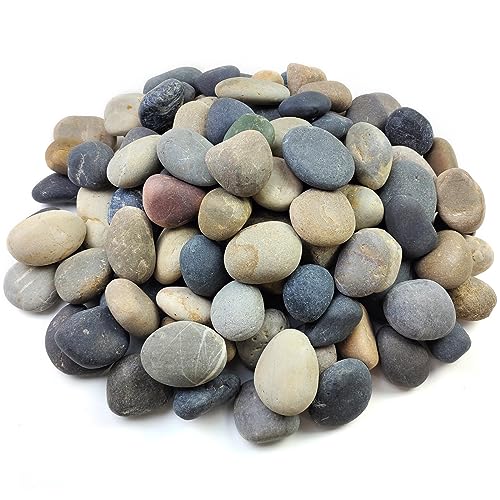
FANTIAN 20 lbs Natural River Rocks, 2-3 Inch Pebbles Rocks for Landscaping
$39.99
View on Amazon →Prices as of Sep 25, 2026, 6:18 PM UTC. Product prices and availability are accurate as of the date/time indicated and are subject to change. Any price and availability information displayed on Amazon.com at the time of purchase will apply to the purchase of this product.
Frequently asked questions
Is pea gravel or crushed stone better for a driveway?
Crushed stone, without question. Pea gravel is rounded and will not lock together, so it ruts under tires and migrates off the driveway. Crushed stone is angular and compacts into a stable surface.
Can you walk barefoot on crushed stone?
Not comfortably — the angular edges are sharp. Pea gravel is the rounded, barefoot-friendly option, which is why it is used around pools and play areas.
Does pea gravel compact?
No. Rounded stone has no interlock, so it stays loose no matter how much you compact it. That is why it always needs edging and a compacted base underneath.
Which is cheaper, pea gravel or crushed stone?
Crushed stone. Crusher run runs $22–$40 per ton and #57 stone $30–$55, while pea gravel costs $35–$70 per ton because it requires washing and screening.
Get your gravel estimate in 60 seconds
Free, no signup required.
Building something else? Try our sister calculators
Smart Roofing Calculator
Free roof replacement cost estimates by material and pitch.
Smart Decking Calculator
Deck cost, boards, joists, and stair estimates.
Smart Fencing Calculator
Fence cost by material and linear footage.
Smart Tile Calculator
Tile quantity, grout, and thinset estimates.
Smart Insulation Calculator
R-value, batt count, and blown-in coverage.
Smart Decking Calculator
Android app — deck cost, boards, and framing on site.
Smart Drywall Calculator
Android app — drywall sheets, mud, and tape estimates.
Smart Sod Calculator
Android app — sod rolls, pallets, and coverage.
Smart Insulation Calculator
Android app — R-value and batt coverage.
Smart Tile Calculator
Android app — tile, grout, and thinset quantities.
Smart Fencing Calculator
Android app — fence cost estimates on the go.