Dry Well Calculator
A dry well is a pit filled with clean stone that holds a storm's runoff while it soaks into the ground. Only the gaps between the stones hold water — about 40% of the pit for clean #57 stone — so the pit has to be about two and a half times the volume of the water. Enter the roof area draining to it, the storm depth and the pit depth for the water volume, the stone in cubic yards and tons, the pit size and the filter fabric to wrap it.
What you'll need
As an Amazon Associate I earn from qualifying purchases.
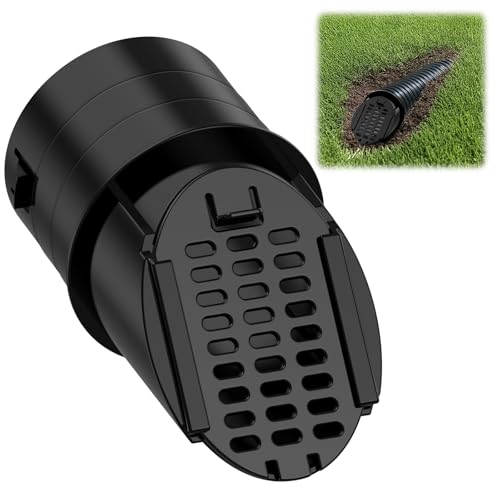
1 Pack 4" Drainage Grate Cover, Rain Diverter, Drainage Grate Yard Drain, Drain Emitter for Sump Pump Discharge & Downspout Extensions, Fit 4" SCH 40, 4" SDR 35, 4" Corrugated Pipe-Black
$19.99
Check price on Amazon
FEED GARDEN Landscape Staples 6 Inch 50 Pack, Galvanized Garden Stakes
$9.99
Check price on Amazon
VNIMTI Heavy Duty Gardening Shovel, 56 Inch Round Blade with Fiberglass Handle (Orange)
Save 5%
$31.34List Price:: $32.99

2 Pack Rain Gutter Downspout Extensions, Upgraded Flexible Drain Down Spout Extender for Rain Water Drainage, Each Extendable from 20" to 66", Combine to 10 ft with Connector(White)
$25.99
Check price on AmazonPrices and savings as of Sep 30, 2026, 4:34 AM UTC. Product prices and availability are accurate as of the date/time indicated and are subject to change. Any price and availability information displayed on Amazon.com at the time of purchase will apply to the purchase of this product.
How a dry well works
A dry well takes the water from a downspout, holds it in the gaps between clean stones, and lets it soak into the soil over the following hours. Only the voids hold water — about 40% of a pit of clean, uniformly graded stone such as #57, which is the design value stormwater manuals such as Pennsylvania's use — so the pit must be about two and a half times the volume of the storm it has to hold.
Worked example: 1,000 sq ft of roof, 1 inch storm, 3 ft deep
| Step | Working | Result |
|---|---|---|
| Runoff | 1,000 × 1 ÷ 12 | 83.3 ft³ = 623 gallons |
| Stone volume | 83.3 ÷ 0.40 | 208.3 ft³ = 7.72 yd³ |
| Stone weight | 7.72 × 1.4 | 10.8 tons of #57 |
| Pit footprint | 208.3 ÷ 3 | 69.4 sq ft, about 8.3 × 8.3 ft |
| Fabric | top + bottom + four sides | about 239 sq ft |
The runoff figure is the USGS one: an inch of rain on an acre is 27,154 gallons, or 0.623 gallons per square foot. Use the roof's footprint, not its sloped area — rain falls vertically.
Before you dig
- Do a percolation test: dig a hole to the pit depth, fill it with water, and time how fast it drains. Slow clay soil may need a bigger pit or a different solution.
- Wrap the stone in non-woven filter fabric so soil does not wash into the voids.
- Follow your local rules for setbacks from the house, property lines and septic systems, and call 811 before digging.
- Use only washed stone — the #57 stone calculator prices it for other jobs, and a French drain is the answer when water needs carrying away rather than holding.
Get the Gravel & Stone Calculator app for Android
Estimate gravel, stone, sand, and mulch on the job site, save projects, and share quantities with your supplier.
Building something else? Try our sister calculators
Smart Roofing Calculator
Free roof replacement cost estimates by material and pitch.
Smart Decking Calculator
Deck cost, boards, joists, and stair estimates.
Smart Fencing Calculator
Fence cost by material and linear footage.
Smart Tile Calculator
Tile quantity, grout, and thinset estimates.
Smart Insulation Calculator
R-value, batt count, and blown-in coverage.
Smart Decking Calculator
Android app — deck cost, boards, and framing on site.
Smart Drywall Calculator
Android app — drywall sheets, mud, and tape estimates.
Smart Sod Calculator
Android app — sod rolls, pallets, and coverage.
Smart Insulation Calculator
Android app — R-value and batt coverage.
Smart Tile Calculator
Android app — tile, grout, and thinset quantities.
Smart Fencing Calculator
Android app — fence cost estimates on the go.
Frequently asked questions
- How big should a dry well be?
- Big enough that its voids hold the design storm. Water volume = drainage area × rainfall (in) ÷ 12; stone volume = water ÷ 0.40 for clean stone. A 1,000 sq ft roof in a 1 inch storm sheds 83.3 cubic feet (623 gallons), so the pit needs 208 cubic feet of stone — about 8.3 × 8.3 ft at 3 ft deep.
- How much gravel do I need for a dry well?
- Pit volume ÷ 27 for cubic yards, × 1.4 for tons of #57 stone. The 208 cubic foot example is 7.72 cubic yards, or about 10.8 tons. A prefabricated dry well chamber holds more water per cubic foot and needs far less stone around it.
- How many gallons of water come off my roof in a storm?
- About 0.623 gallons per square foot per inch of rain — the USGS figure of 27,154 gallons for one inch on an acre, divided by 43,560 sq ft. A 1,000 sq ft roof sheds about 623 gallons in a 1 inch storm; the sloped area does not matter, only the footprint.
- What gravel is best for a dry well?
- Clean, washed, uniformly graded stone such as #57 or #3. Stormwater design manuals such as Pennsylvania's use a 40% void ratio for this kind of stone. Never use crusher run or anything with fines — the fines fill the voids and the well stops working.
Related calculators
All calculators →
French Drain Gravel Calculator
Gravel, pipe, and fabric quantities for a French drain trench of any length and depth.
Open calculator →
Paver Base Calculator
Base gravel and bedding sand for a paver patio, walkway, or driveway.
Open calculator →
Shed & Pad Base Calculator
Gravel pad for a shed, hot tub, HVAC unit, or parking area, sized with the correct overhang.
Open calculator →